Khóa học
IELTS Online
IELTS Online
Giảm đến 18%
Đăng ký ngay
Mục lục [Ẩn]
Trong bài viết này Langmaster sẽ mang đến cho bạn phần luyện tập đầy đủ với đề thi IELTS Reading “Having A Laugh”, bao gồm toàn bộ đề bài, hệ thống câu hỏi, đáp án chi tiết cùng phần giải thích rõ ràng. Đây sẽ là nguồn tài liệu giá trị hỗ trợ bạn rèn luyện kỹ năng Reading và tiến gần hơn đến mục tiêu band điểm mong muốn trong kỳ thi IELTS.
The findings of psychological scientists reveal the importance of humor
A. Humans start developing a sense of humour as early as six weeks old, when babies begin to laugh and smile in response to stimuli. Laughter is universal across all human cultures and even exists in some form in rats, chimps, and bonobos. Like other human emotions and expressions, laughter and humour provide psychological scientists with rich resources for studying human psychology, ranging from the development of language to the neuroscience of social perception.
B. Theories focusing on the evolution of laughter point to it as an important adaptation for social communication. Take, for example, the recorded laughter in TV comedy shows. Back in 1950, US sound engineer Charley Douglass hated dealing with the unpredictable laughter of live audiences, so started recording his own ‘laugh tracks’. These were intended to help people at home feel like they were in a social situation, such as a crowded theatre. Douglass even recorded various types of laughter, as well as mixtures of laughter from men, women, and children. In doing so, he picked up on a quality of laughter that is now interesting researchers: a simple ‘haha’ communicates a remarkable amount of socially relevant information.
C. In one study conducted in 2016, samples of laughter from pairs of English-speaking students were recorded at the University of California, Santa Cruz. A team made up of more than 30 psychological scientists, anthropologists, and biologists then played these recordings to listeners from 24 diverse societies, from indigenous tribes in New Guinea to city-dwellers in India and Europe. Participants were asked whether they thought the people laughing were friends or strangers. On average, the results were remarkably consistent: worldwide, people’s guesses were correct approximately 60% of the time.
D. Researchers have also found that different types of laughter serve as codes to complex human social hierarchies. A team led by Christopher Oveis from the University of California, San Diego, found that high-status individuals had different laughs from low-status individuals, and that strangers’ judgements of an individual’s social status were influenced by the dominant or submissive quality of their laughter. In their study, 48 male college students were randomly assigned to groups of four, with each group composed of two low-status members, who had just joined their college fraternity group, and two high-status members, older students who had been active in the fraternity for at least two years. Laughter was recorded as each student took a turn at being teased by the others, involving the use of mildly insulting nicknames. Analysis revealed that, as expected, high-status individuals produced more dominant laughs and fewer submissive laughs relative to the low-status individuals. Meanwhile, low-status individuals were more likely to change their laughter based on their position of power; that is, the newcomers produced more dominant laughs when they were in the ‘powerful’ role of teasers. Dominant laughter was higher in pitch, louder, and more variable in tone than submissive laughter.
E. A random group of volunteers then listened to an equal number of dominant and submissive laughs from both the high- and low-status individuals, and were asked to estimate the social status of the laughter. In line with predictions, laughers producing dominant laughs were perceived to be significantly higher in status than laughers producing submissive laughs. ‘This was particularly true for low-status individuals, who were rated as significantly higher in status when displaying a dominant versus submissive laugh,’ Oveis and colleagues note. ‘Thus, by strategically displaying more dominant laughter when the context allows, low-status individuals may achieve higher status in the eyes of others.’ However, high-status individuals were rated as high-status whether they produced their natural dominant laugh or tried to do a submissive one.
F. Another study, conducted by David Cheng and Lu Wang of Australian National University, was based on the hypothesis that humour might provide a respite from tedious situations in the workplace. This ‘mental break’ might facilitate the replenishment of mental resources. To test this theory, the researchers recruited 74 business students, ostensibly for an experiment on perception. First, the students performed a tedious task in which they had to cross out every instance of the letter ‘e’ over two pages of text. The students then were randomly assigned to watch a video clip eliciting either humour, contentment, or neutral feelings. Some watched a clip of the BBC comedy Mr. Bean, others a relaxing scene with dolphins swimming in the ocean, and others a factual video about the management profession.
G. The students then completed a task requiring persistence in which they were asked to guess the potential performance of employees based on provided profiles, and were told that making 10 correct assessments in a row would lead to a win. However, the software was programmed such that it was nearly impossible to achieve 10 consecutive correct answers. Participants were allowed to quit the task at any point. Students who had watched the Mr. Bean video ended up spending significantly more time working on the task, making twice as many predictions as the other two groups.
H. Cheng and Wang then replicated these results in a second study, during which they had participants complete long multiplication questions by hand. Again, participants who watched the humorous video spent significantly more time working on this tedious task and completed more questions correctly than did the students in either of the other groups.
I. ‘Although humour has been found to help relieve stress and facilitate social relationships, traditional view of task performance implies that individuals should avoid things such as humour that may distract them from the accomplishment of task goals,’ Cheng and Wang conclude. ‘We suggest that humour is not only enjoyable but more importantly, energizing.
Questions 27–31
Choose the correct letter, A, B, C or D.
27. When referring to laughter in the first paragraph, the writer emphasises.
28. What does the writer suggest about Charley Douglass?
29. What makes the Santa Cruz study particularly significant?
30. Which of the following happened in the San Diego study?
31. In the fifth paragraph, what did the results of the San Diego study suggest?
Questions 32-36
Complete the summary using the list of words, A-H, below.
The Benefits of Humour
In one study at Australian National University, randomly chosen groups of participants were shown one of three videos, each designed to generate a different kind of 32…………. When all participants were then given a deliberately frustrating task to do, it was found that those who had watched the 33………..video persisted with the task for longer and tried harder to accomplish the task than either of the other two groups. A second study in which participants were asked to perform a particularly 34……….. task produced similar results. According to researchers David Cheng and Lu Wang, these findings suggest that humour not only reduces 35…………… and helps build social connections but it may also have a 36………………….. effect on the body and mind.
|
A. laughter B. relaxing C. boring D. anxiety |
E. stimulating F. emotion G. enjoyment H. amusing |
Questions 37-40
Do the following statements agree with the claims of the writer in Reading Passage 3?
YES : if the statement agrees with the views of the writer
NO: if the statement contradicts what the writer thinks
NOT GIVEN if it is impossible to know what the writer’s point of view is
37. Participants in the Santa Cruz study were more accurate at identifying the laughs of friends than those of strangers.
38. The researchers in the San Diego study were correct in their predictions regarding the behaviour of the high-status individuals.
39. The participants in the Australian National University study were given a fixed amount of time to complete the task focusing on employee profiles.
40. Cheng and Wang’s conclusions were in line with established notions regarding task performance.
>> Xem thêm:
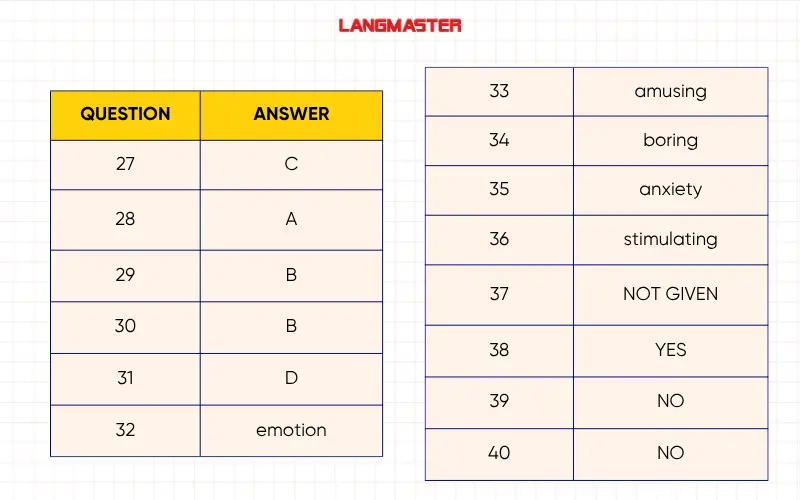
27. Đáp án: C
Thông tin đoạn A: “Laughter is universal across all human cultures and even exists in some form in rats, chimps, and bonobos. Like other human emotions and expressions, laughter and humour provide psychological scientists with rich resources for studying human psychology…”
Giải thích: Đoạn này nêu rằng tiếng cười không chỉ phổ biến mà còn giúp các nhà khoa học nghiên cứu tâm lý con người. Cụm “provide psychological scientists with rich resources for studying human psychology” cho thấy tác giả muốn nhấn mạnh giá trị của tiếng cười đối với nghiên cứu khoa học chứ không phải văn hóa hay ngôn ngữ.
28. Đáp án: A
Thông tin đoạn B: “Douglass hated dealing with the unpredictable laughter of live audiences, so started recording his own ‘laugh tracks’. These were intended to help people at home feel like they were in a social situation, such as a crowded theatre.”
Giải thích: Mục đích của ông là tạo cảm giác được cười cùng người khác, giống như đang ở rạp hát, tức là nhấn mạnh tầm quan trọng của việc thưởng thức hài hước trong môi trường xã hội. Không có chi tiết nào nói ông “ra lệnh khi nào cười” hay “thích khán giả trực tiếp”.
29. Đáp án: B
Thông tin đoạn C: “Listeners from 24 diverse societies, from indigenous tribes in New Guinea to city-dwellers in India and Europe… On average, the results were remarkably consistent: worldwide, people’s guesses were correct approximately 60% of the time.”
Giải thích: Mặc dù nghiên cứu có sự tham gia của nhiều nền văn hóa khác nhau, kết quả vẫn đồng nhất trên toàn cầu, chứng tỏ con người ở mọi nơi đều có khả năng hiểu tiếng cười theo cách tương tự.
30. Đáp án: B
Thông tin đoạn D: “Each student took a turn at being teased by the others… Low-status individuals were more likely to change their laughter based on their position of power; that is, the newcomers produced more dominant laughs when they were in the ‘powerful’ role of teasers.”
Giải thích: Đoạn này cho biết mọi sinh viên lần lượt đổi vai – khi thì bị trêu, khi thì trêu người khác (“took a turn at being teased”). Điều đó nghĩa là họ đổi vai trò (exchange roles) trong thí nghiệm.
31. Đáp án: D
Thông tin đoạn E: “Laughers producing dominant laughs were perceived to be significantly higher in status… High-status individuals were rated as high-status whether they produced their natural dominant laugh or tried to do a submissive one.”
Giải thích: Kết quả cho thấy người địa vị cao luôn được đánh giá là có địa vị cao, dù họ cười kiểu nào. Như vậy, người có địa vị cao luôn được nhận ra qua cách cười.
32. Đáp án: F. emotion
Từ loại cần điền: Danh từ
Thông tin đoạn F: “The students then were randomly assigned to watch a video clip eliciting either humour, contentment, or neutral feelings.”
Giải thích: Mục đích của ba video là “gây ra các cảm xúc khác nhau” (humour = vui, contentment = hài lòng, neutral = trung tính). => Từ cần điền ở đây là danh từ chỉ một loại cảm xúc.
33. Đáp án: H. amusing
Thông tin đoạn G: “Students who had watched the Mr. Bean video ended up spending significantly more time working on the task…”
Từ loại cần điền: Tính từ
Giải thích:
34. Đáp án: C. boring
Từ loại cần điền: Tính từ
Thông tin đoạn H: “... participants complete long multiplication questions by hand. Again, participants who watched the humorous video spent significantly more time working on this tedious task…”
Giải thích: Từ khóa tương đương trong bài: tedious task → nghĩa là nhàm chán.
35. Đáp án: D. anxiety
Từ loại cần điền: Danh từ
Thông tin đoạn I: “Although humour has been found to help relieve stress and facilitate social relationships…”
Giải thích: “reduce stress” → nghĩa tương đương là giảm lo âu, căng thẳng.
36. Đáp án: E. stimulating
Từ loại cần điền: Tính từ
Thông tin đoạn I: “We suggest that humour is not only enjoyable but more importantly, energizing.”
Giải thích: Cụm “energizing effect” có nghĩa là “hiệu ứng kích thích, tiếp thêm năng lượng”.
37. Đáp án: NOT GIVEN
Thông tin đoạn C: “Participants were asked whether they thought the people laughing were friends or strangers. On average, the results were remarkably consistent: worldwide, people’s guesses were correct approximately 60% of the time.”
Giải thích: Đoạn này chỉ nói rằng người tham gia đoán đúng khoảng 60%, chứ không nói họ nhận diện tiếng cười của bạn bè chính xác hơn tiếng cười của người lạ. Không có thông tin so sánh giữa hai nhóm tiếng cười.
38. Đáp án: YES
Thông tin đoạn D: “Analysis revealed that, as expected, high-status individuals produced more dominant laughs and fewer submissive laughs relative to the low-status individuals.”
Giải thích: Cụm “as expected” cho thấy kết quả đúng như dự đoán của các nhà nghiên cứu, nghĩa là họ đã dự đoán chính xác hành vi của người có địa vị cao (high-status individuals).
39. Đáp án: NO
Thông tin đoạn G: “Participants were allowed to quit the task at any point.”
Giải thích: Ngược lại với câu hỏi, đoạn văn khẳng định rằng người tham gia có thể dừng bất kỳ lúc nào, chứ không bị giới hạn thời gian cố định.
40. Đáp án: NO
Thông tin đoạn I: “Although humour has been found to help relieve stress and facilitate social relationships, traditional view of task performance implies that individuals should avoid things such as humour that may distract them from the accomplishment of task goals.
We suggest that humour is not only enjoyable but more importantly, energizing.”
Giải thích:
>> Xem thêm:
Để hiểu sâu và trả lời chính xác các câu hỏi trong bài Having a laugh, bạn cần nắm vững những từ vựng học thuật thường xuất hiện trong chủ đề psychology, communication, và human behavior. Những từ này không chỉ giúp bạn đọc hiểu nhanh hơn mà còn có thể áp dụng hiệu quả trong IELTS Speaking và Writing khi nói về cảm xúc, tiếng cười hay các mối quan hệ xã hội.
Dưới đây là bảng tổng hợp các từ và cụm từ quan trọng nhất trong bài, kèm theo từ loại – nghĩa – ví dụ để bạn dễ ghi nhớ và sử dụng.
Để hiểu sâu và làm tốt các bài đọc học thuật như Having a laugh, người học không chỉ cần vốn từ vựng rộng mà còn phải biết phân tích ngữ cảnh, nắm ý chính và nhận biết cấu trúc câu hỏi IELTS Reading. Đây là kỹ năng khó tự rèn nếu không có lộ trình và sự hướng dẫn phù hợp.
Với hơn 16 năm kinh nghiệm đào tạo tiếng Anh và luyện thi IELTS, Langmaster mang đến khóa học IELTS Online giúp bạn phát triển toàn diện 4 kỹ năng. Lộ trình học được cá nhân hóa theo trình độ từng học viên, cùng đội ngũ giảng viên chuyên môn cao, giúp bạn nâng band IELTS hiệu quả và tự tin đạt mục tiêu mong muốn.

Hãy đăng ký ngay hôm nay để được HỌC THỬ MIỄN PHÍ trước khi quyết định đăng ký chính thức.
Having a laugh không chỉ mang lại kiến thức thú vị về khoa học của tiếng cười, mà còn giúp thí sinh luyện khả năng phân tích ý chính, xác định từ khóa và tư duy logic – những kỹ năng quan trọng để đạt điểm cao trong IELTS Reading. Khi học và ghi nhớ các từ vựng học thuật, bạn sẽ dễ dàng mở rộng vốn từ và áp dụng linh hoạt trong cả phần Writing và Speaking.



Các dạng bài phổ biến và tiêu chí chấm điểm IELTS Reading chi tiết nhất: Multiple Choice, Matching Information, Matching Headings,... và hướng dẫn chiến lược làm bài hiệu quả
Những sai lầm khi luyện IELTS Reading bao gồm: dịch từng từ, đọc hết cả bài, không đọc câu hỏi trước, không quản lý thời gian, không nắm vững kỹ năng paraphrase, viết sai chính tả
![Giải đề IELTS Reading: A brief history of humans and food [full answers]](https://langmaster.edu.vn/storage/images/2025/09/20/a-brief-history-of-humans-and-food-ielts-reading-answers.webp)
Giải đề thi IELTS Reading “A brief history of humans and food” kèm full đề thi thật, câu hỏi, đáp án, giải thích chi tiết, và từ vựng cần lưu ý khi làm bài.
Tổng hợp IELTS Reading tips hay nhất giúp bạn đọc nhanh, nắm ý chính và xử lý thông tin chính xác, tự tin đạt điểm cao trong kỳ thi IELTS.
![Giải đề IELTS Reading: The importance of law [Full answers]](https://langmaster.edu.vn/storage/images/2025/09/22/55.webp)
Giải đề IELTS Reading “The importance of law” kèm đáp án chi tiết, từ vựng quan trọng và bí quyết luyện thi hiệu quả để nâng cao band điểm.





Hơn 16 năm kinh nghiệm, đào tạo thành công 800.000+ học viên
Phương pháp giảng dạy hiện đại, học viên tiến bộ rõ rệt
Lộ trình học chuẩn quốc tế, phù hợp với nhu cầu thực tiễn
Giáo viên đạt chuẩn Quốc tế với chất lượng top đầu thị trường, giàu kinh nghiệm
Học online linh hoạt, cam kết đầu ra bằng văn bản

![Giải đề IELTS Reading: The Voynich Manuscript [Full answers]](https://langmaster.edu.vn/storage/uploads/original/2025/10/15/voynich-manuscript-ielts-reading.png)